
She Started at 78. By 93, She Was on the Cover of TIME.
We've all been sold a lie. "Too late" is the most elegant self-destruction device ever invented.

September 7, 1860. Greenwich, New York. A girl is born on a farm.
Her name is Anna Mary Robertson. She’s the third of ten children. Her father runs a flax mill and works the land. At twelve, Anna leaves home to work as a hired hand for wealthy neighbors — cooking, cleaning, sewing. She does this for fifteen years.
At twenty-seven, she marries a farmhand named Thomas Moses. For the next two decades, they move between five farms in Virginia. She gives birth to ten children. Five survive. To make extra money, she makes potato chips and churns butter. She saves enough to buy a cow.
In 1905, the family moves back to Eagle Bridge, New York. In 1927, Thomas dies of a heart attack. Anna doesn’t remarry. Her son Forrest helps her run the farm.
In 1936, Anna is seventy-six. She “retires” and moves in with her daughter.
If the story ended here, Anna Mary Robertson Moses would be an ordinary farm wife. Her life would compress into a few lines on a gravestone, then fade.
But the story doesn’t end here.
Arthritis
Anna had always loved embroidery. She stitched the seasons of farm life into cloth with colored thread — the morning milking, the winter maple sugaring, the jack-o’-lanterns at Halloween. It was one of the few things that belonged entirely to her.
At seventy-six, arthritis arrived.
Her fingers swelled. Her joints stiffened. She couldn’t hold a needle anymore. The doctor said embroidery was over. Her sister Celestia made an offhand suggestion: “Why don’t you paint? Painting’s easier than embroidery.”
Anna listened.
She dug out whatever house paint was left in the shed. She found some scrap wood and old fireboards. And she started painting. Not the farm as it was — the farm as she remembered it from fifty years earlier, when she was a girl. No telephone poles. No tractors. None of the things that came later. She painted an America that had already disappeared.
She had never taken an art lesson. She didn’t know perspective. She didn’t know color theory. She had never set foot in a studio.
She just painted.
Anna was seventy-eight.
The Drugstore Window
Spring, 1938. A New York engineer and art collector named Louis Caldor is driving through the town of Hoosick Falls. He has a sharp eye.
He sees some paintings in a drugstore window.
Farm scenes. Milking. Sugaring-off. Children at Halloween. The brushwork is clumsy, but the colors are bold in a way that doesn’t feel amateur. Caldor walks in and asks who painted them. The clerk says some old woman put them here on consignment. Lives up in Eagle Bridge, I think.
Caldor drives to Eagle Bridge.
He finds Anna’s house. She’s reluctant to sell — she thinks the paintings are worthless, just something she does to pass the time. Caldor insists. He buys everything she has. Maybe a dozen paintings.
He takes them to New York. He knocks on gallery doors.
Nobody wants them.
The gallery owners take one look and say: folk art? Painted by an old woman? No market. And she’s seventy-eight — how many years does she even have left?
Caldor doesn’t give up. In 1940, he persuades Otto Kallir of Galerie St. Etienne to give Anna a solo show. The exhibition is called “What a Farmwife Painted.”
Anna is eighty.
She doesn’t go to the opening. She stays on the farm. She keeps painting.
TIME
What happened next, nobody could have predicted.
Anna’s paintings started selling. First for a few dozen dollars. Then a few hundred. Then thousands.
By 1946, her work was on greeting cards, calendars, magazine covers. Her name had become a brand — “Grandma Moses.” The nickname came from a New York Herald Tribune reporter who casually used what the neighbors called her, and it stuck forever.
In 1948, at eighty-eight, she was named “Young Woman of the Year” by Mademoiselle magazine.
In 1949, President Truman invited her to the White House.
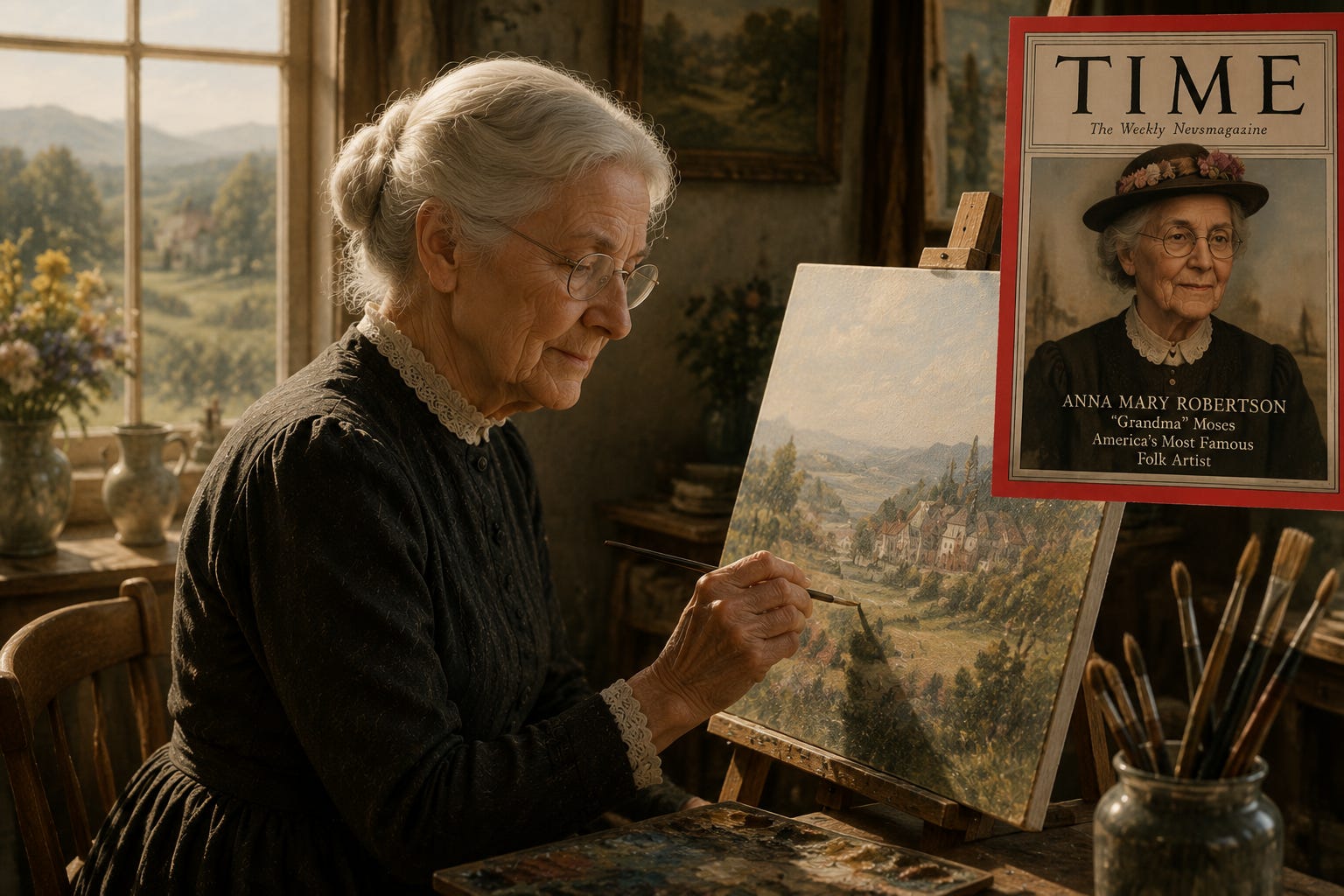
In December 1953, at ninety-three, Anna Mary Robertson Moses appeared on the cover of TIME magazine.
A farm wife who started painting at seventy-eight. A woman who never took a single art class. An amateur discovered in a drugstore window. She was now the most famous living artist in America.
She would go on to paint more than 1,500 works. In 2006, one of her paintings sold at auction for $1.36 million.
She painted until a few months before her death. On December 13, 1961, Anna died at 101.
The Postcard to Junichi Watanabe
There’s a detail here that I think about constantly.
In 1960, Grandma Moses was 100. She received a letter from Japan. The sender was a young man who ran a small medical clinic in his hometown. But what he really wanted to do was write. He didn’t know whether to give up a stable career as a doctor to chase something that might never work out. He asked Grandma Moses: what should I do?
She sent him a postcard. It said:
“Do what you love. God will help you open the door, even if you’re 80 years old.”
The young man’s name was Junichi Watanabe.
He quit his clinic. He became one of Japan’s most celebrated authors — A Lost Paradise, Light and Shadow, The Distant Sunset. His books shaped an entire generation of Japanese readers. And it all started with a few dozen words on a postcard from a hundred-year-old American woman.
“Too Late” Is a Lie
I’m not telling you this to give you an inspirational story.
The problem with inspirational stories is that they move you for five minutes, and then you close the tab and go back to your life. They don’t change anything.
I’m trying to say something else.
I’m trying to say: “too late” might be the most elegant self-destruction device the human mind has ever invented.
It looks like an objective assessment — “I’m too old to learn this,” “the window for that industry has closed,” “it’s too late to switch careers.” But it’s not an objective assessment. It’s fear dressed up as fact.
Psychologists have a name for this: temporal rigidity belief — the rigid assumption you carry about your life’s timeline. You default to believing there’s a standard schedule: what you’re supposed to accomplish by what age, and after a certain point, it’s “too late.” This belief is so deeply embedded that you don’t even recognize it as a belief. You mistake it for reality.
But it’s not reality.
When Grandma Moses started painting at seventy-eight, she didn’t know what “too late” meant. Not because she was especially brave. Because she had never been included in that timeline in the first place. She was a farm wife. Nobody expected her to become an artist. She didn’t need to “succeed” by a certain age. She painted because she couldn’t embroider anymore, and she wanted to make something.
That was her greatest advantage.
She didn’t have the concept of “too late,” so it couldn’t stop her.
You’re Not Afraid of Running Out of Time. You’re Afraid of Starting.
There’s something deeper here. Let me try to get at it.
When we tell ourselves it’s “too late,” what we’re really saying, most of the time, is not “I don’t have enough time.” What we’re really saying is: “I’m afraid that if I start, I’ll discover I’m not good enough.”
“Too late” is a perfect excuse. Because it shifts the blame for failure from you onto time. It’s not that you weren’t good enough. It’s that time wasn’t on your side. It’s not that you failed. It’s that you missed the window. This excuse protects you — it spares you from having to face the much scarier possibility: that you might genuinely not be good enough, that you might actually fail, that you might pour everything in and get nothing back.
Grandma Moses didn’t have this problem.
Not because she was confident. Because she never asked herself whether she was “good enough.” She painted because she wanted to paint. She didn’t set out to become an artist. She didn’t plan to sell her work. She didn’t dream of the cover of TIME. She just woke up every morning, mixed her paints, and put down on a board what she remembered of the farm.
She wasn’t chasing success. She was just doing a thing.
That’s the difference.
When you’re chasing success, every setback is a verdict on your worth. When you’re just doing a thing, setbacks are just part of doing the thing. You don’t need to “believe in yourself.” You just need to keep going.
The “Right Time” You’ve Been Waiting For
I know people — you probably do too — who are always waiting.
Waiting for the kids to go to college. Waiting for work to settle down. Waiting for the mortgage to be paid off. Waiting to save enough. Waiting for retirement. Waiting for the “right time.”
That time has never come. It never will.
Because the “right time” isn’t a moment. It’s a decision. The moment you decide to start — that’s the right time. Before that, no conditions are good enough. After that, all conditions are good enough. Not because the conditions changed. Because you changed.
Grandma Moses didn’t wait. She got arthritis at seventy-six. She picked up a paintbrush at seventy-seven. She didn’t say “let me wait until my fingers feel better.” She didn’t say “let me learn the basics first.” She didn’t say “who’s going to look at paintings by someone my age?”
She just started.
Your Life Is Not a Downward Slope
The default model of life we carry around is wrong.
We think life is a parabola: rise, peak, decline. We think creativity has an expiration date. We think our “best years” fall within a certain age range, and after that, it’s over.
Grandma Moses drew a completely different curve with her life.
Her creativity didn’t decline with age. It increased. Before seventy-eight, she had never painted a single serious picture. After seventy-eight, she painted 1,500. Her best work — the pieces that museums later acquired, that auction houses fought over — was mostly done after she was eighty-five.
Her peak happened after the age when most people believe life is already over.
This is not an exception. This is a signal.
It tells us that the rise-peak-decline model is broken. Life is not a parabola. Life is an unmapped wilderness. You can start walking in any direction, at any age, from any point. Nobody can tell you which path is right, because nobody has walked yours.
One Last Thing
Grandma Moses said something once. I’ll leave it here:
“Life is what we make it, always has been, always will be.”
She was in her nineties when she said this. She wasn’t dispensing wisdom. She was stating a fact she’d spent a lifetime verifying.
Picked up a paintbrush at seventy-eight. First solo show at eighty. Named “Young Woman of the Year” at eighty-eight. TIME cover at ninety-three. At a hundred, she wrote a postcard to a lost young man in Japan and changed his life. Died at 101, leaving behind 1,500 paintings and a completely rewritten definition of what “late” means.
She never said “too late.”
Neither should you.
If this resonated, share it with someone who’s been waiting for the right moment. It might be now.
Anna Mary Robertson Moses (1860–1961) painted more than 1,500 works over three decades. Her paintings hang in the Smithsonian American Art Museum, the Metropolitan Museum of Art, and the White House. The largest collection of her work is at the Bennington Museum in Vermont. A major retrospective, “Grandma Moses: A Good Day’s Work,” is currently on view at the Smithsonian American Art Museum through July 2026.